Guide
Dacor vs Thermador: Design, Reliability and Repair Compared
A fair Dacor vs Thermador comparison for homeowners: burner and oven design, build, common failures, parts access and typical repair ranges.
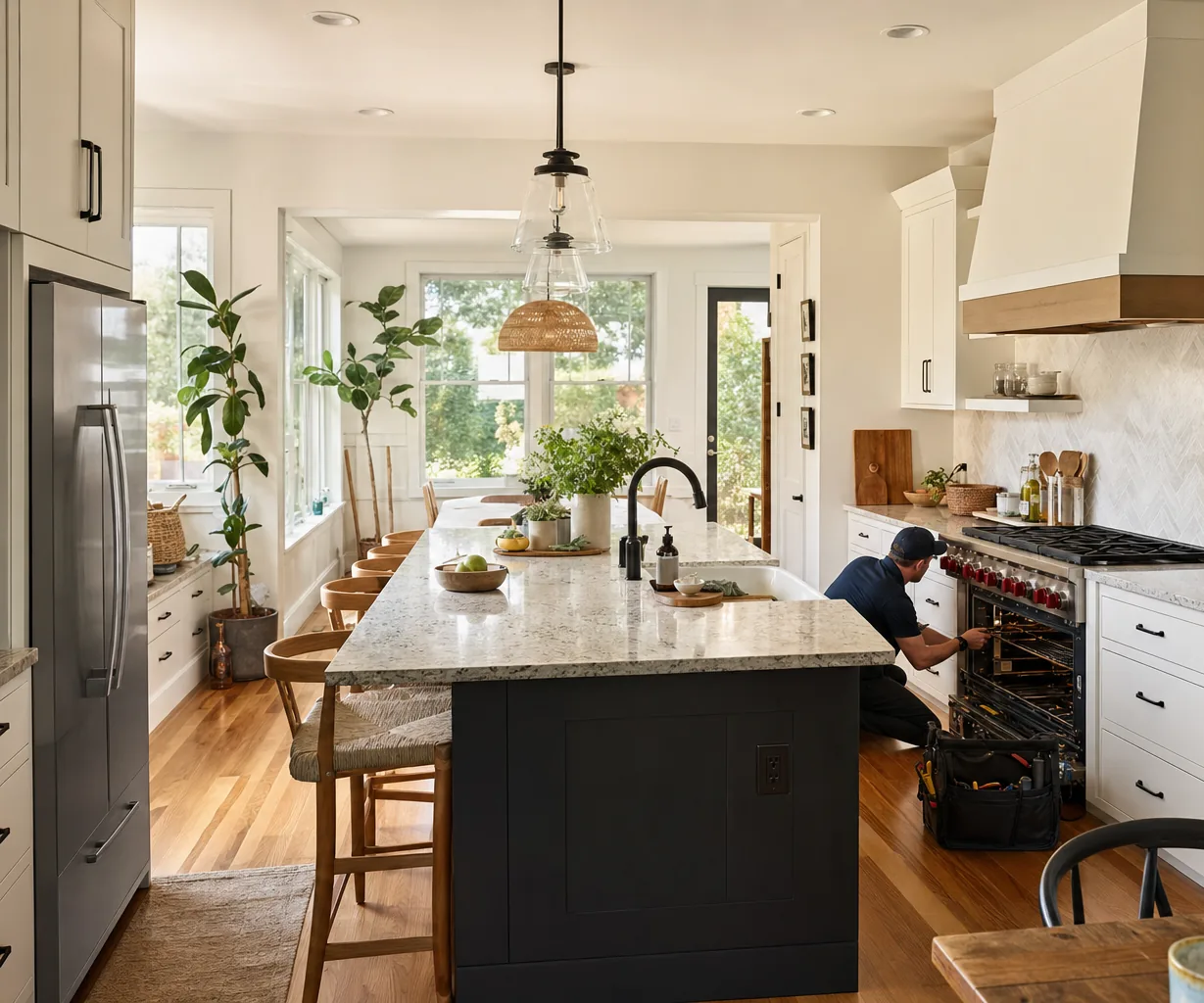
Dacor vs Thermador is a close call between two premium built-in cooking brands: Thermador suits cooks who want powerful gas burners and a very low simmer, while Dacor suits buyers who put design, illuminated controls and connected features first. Either one commonly lasts 13–15 years with reasonable care, and typical repairs on both fall in the same $250–$900 range for a range or oven, so choose on how you cook rather than on fear of service.
Thermador belongs to BSH, the Bosch group, and Dacor has been owned by Samsung since 2016. That ownership shapes parts supply and software more than the steel and burners you use every day.
How do Dacor and Thermador differ in design and construction?
Thermador’s identity is the gas burner. Its patented five-point burner spreads flame ports along a longer edge than a round burner, carrying heat closer to the rim of a wide skillet. Many Thermador gas models add ExtraLow, which cycles a burner on and off to hold a gentler simmer than a steady flame can. Its Freedom induction cooktop treats nearly the whole glass surface as one cooking area.
Dacor’s identity is design. Its ranges are known for illuminated knobs that glow when a burner is on, and newer models lean on touch screens and Wi-Fi control through Samsung’s SmartThings app. Dacor dual-fuel ranges pair gas burners with an electric convection oven, and several add steam assist. Thermador offers app control too, through Home Connect, so the difference is emphasis rather than capability.
| Feature | Thermador | Dacor |
|---|---|---|
| Parent company | BSH (Bosch group) | Samsung (since 2016) |
| Signature gas feature | Five-point burner, ExtraLow simmer | Illuminated knobs, wide heat range |
| Induction approach | Full-surface Freedom plus zoned models | Zoned induction cooktops and ranges |
| Control style | Knobs and touch controls, Home Connect | Knobs and touch screens, SmartThings |
| Range widths | 30, 36, 48 and 60 in. | 30, 36 and 48 in. |
Which brand cooks better on gas, induction and in the oven?
On gas, Thermador has the edge for people who sear in large pans and also hold delicate sauces, because the burner shape and ExtraLow cover both ends of the dial. Dacor burners handle high heat and simmering well, and the lit knobs show which burner is on from across the kitchen.
On induction, Thermador’s full-surface design changes how you cook, since pan placement stops mattering. Dacor’s zoned induction behaves like a conventional cooktop with marked circles, which many owners find simpler. Our induction cooktop page explains how both styles work.
For baking, both use true convection, with an element behind the rear fan that keeps several racks even. Dacor’s steam-assisted range ovens suit bakers who want one appliance; Thermador’s wall ovens suit kitchens built around a rangetop and a separate oven column.
Which one is more reliable over the long run?
There is no honest way to name one brand as always more reliable. Both are well built, and both age in predictable ways.
Gas cooking on either brand shares the same weak points: igniters, spark modules and burner ports. Spills that soak into a burner base cause constant clicking or a burner that will not light. Burners that cycle for an ultra-low simmer depend on perfect ignition, so a tired igniter often shows up there first on a Thermador.
Electronics are the second pattern. The more a model relies on touch screens and Wi-Fi, the more often a failure traces back to a control board. Newer Dacor models lean heavily on screens, and Thermador’s touch-control wall ovens are similar.
Ovens on both brands wear bake elements, temperature sensors, convection fan motors and door gaskets, and the very hot self-clean cycle stresses door locks and thermal fuses. Three habits help:
- Wipe burner caps and ports dry after a boil-over and seat the caps flat.
- Skip self-clean in the days right before you host a big meal.
- Replace a torn or flattened door gasket early.
How do parts and service compare?
Thermador parts move through the BSH network, which also supplies Bosch and Gaggenau, and Dacor parts come through Samsung’s supply chain. Parts for current models of both are generally obtainable. For older, discontinued models of either brand, a specific board or valve can be slow to find or no longer made, which matters more than the badge when you weigh repair against replacement.
Tarrytown Wolf Appliance Repair works on Dacor and Thermador ranges, ovens and cooktops as an independent service, not manufacturer-authorized. Call (914) 340-0898 for a diagnosis anywhere from Sleepy Hollow and Irvington to Elmsford.
What do typical repairs cost on either brand?
Cost tracks the part and labor, not the logo, so these typical ranges apply to both brands; the firm quote is given on site after diagnosis. See range repair for what a visit includes.
| Repair | Typical range |
|---|---|
| Diagnostic / service call | $95–$149 |
| Range / oven repair | $250–$900 |
| Oven igniter / bake element | $250–$500 |
| Gas valve / spark module | $300–$650 |
| Control board / electronics | $400–$850 |
| Door gasket / seal replacement | $150–$450 |
Which should a Tarrytown kitchen choose?
Many homes in Tarrytown, Sleepy Hollow and the other Rivertowns are older houses whose kitchens were renovated inside original walls, so the hood duct route and gas line size often decide what fits before the brand does. Many building codes also require make-up air once a hood moves more than 400 CFM. Settle the venting first, then pick: Thermador for hard searing, ultra-low simmering or full-surface induction, Dacor if design and connected controls matter most.
Frequently asked questions
Is Thermador better than Dacor?
Neither is better across the board. Thermador is stronger for gas cooks who want high heat and an ultra-low simmer, while Dacor stands out for design and connected features.
Can one technician repair both brands?
Yes, an experienced independent technician can repair both, because igniters, valves, sensors and boards work on the same principles. Timing usually depends on sourcing the exact part.
Is it worth repairing a 12-year-old Dacor or Thermador range?
Usually yes, if the burners, oven cavity and cabinet are sound and the part is available, since most range and oven repairs fall in the $250–$900 typical range. Replacement makes more sense when a discontinued control board fails or several major parts fail at once.